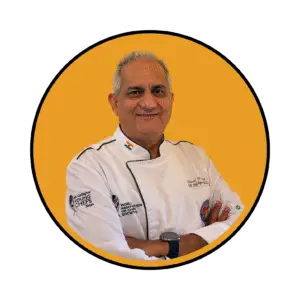
“My executive chef trusted me to run our revolving restaurant in Abu Dhabi. The general manager needed convincing. I had three months to show what I could do, with a full dining room and a new menu every two days.”
I moved to Abu Dhabi from Bahrain in 1993, as a young chef. I was posted to a fine-dining restaurant on a revolving rooftop, specializing in modern European cuisine. Yes, revolving. The whole restaurant turned slowly while you ate, which sounds romantic until you’re the one running food up there and wondering if your table has quietly drifted to the other side of the room. I was part of the pre-opening team. The head chef was a young British chef who had actually started his career as a draftsman. He switched to cooking once he realized that was where his real talent lay, and honestly, the kitchen’s gain was some architecture firm’s loss.
Kerry and I made a formidable team, and together we built a strong team around us. He still carried the precision of a draftsman, and it showed in his plating. Every dish looked like it had been measured with a ruler, because knowing Kerry, it probably had been. I learned a lot from him. I think he learned a fair bit from me too, about running a kitchen and about my style of cooking. We complemented each other well. He brought the geometry; I brought the chaos, and somehow it worked. The restaurant was a big hit from day one. It was fully booked most days, and we usually had a waiting list.
The operation itself was quite a challenge, since the kitchen sat above the restaurant. All the food went down through dumbwaiters. We had two of them. One carried the food; the other carried back the used dishes and silverware, and if you ever mixed up which one was which, you had a very confused waiter staring at an elevator full of dirty forks where the soup was supposed to be. We had a fairly complex system for talking to the restaurant staff, using walkie-talkies. It made us all feel a bit like air traffic control, except instead of landing planes we were trying to land a soufflé on time. Since it was a fine-dining restaurant, every course had to go down separately, one at a time. No shortcuts, no sending everything up together and hoping for the best.
Our routine was demanding. On top of the regular à la carte menu, Kerry and I had to put together a new table d’hôte menu every two days. It kept pushing us to be creative, or at least kept us from repeating ourselves too obviously.
About a year in, Kerry got an opportunity to move to Australia, and he left. That left the hotel with a real question: who would take over the kitchen now that the head chef was gone? My executive chef was confident in me and backed me strongly for the role. The general manager wasn’t so sure. He wasn’t convinced an Indian chef should be running their flagship fine-dining restaurant, which is a polite way of saying he needed some convincing that I wouldn’t accidentally turn it into a curry house overnight.
In the end, my executive chef’s trust won out, and I was put on a three-month trial to see how I’d take the restaurant forward. I remember thinking to myself, I can do it, Chef. I relished the challenge. Over those three months, the restaurant kept growing. Regulars kept coming back, and the guest feedback stayed strongly positive. The GM never quite said he’d been wrong, but he stopped looking quite so worried whenever I walked past. That period really shaped me as a chef. It changed how I built menus, how I dealt with guests, and how I managed the people working under me in the kitchen. I also grew more mature in the way I handled the restaurant manager and his staff, mostly by learning to count to ten before responding to anything said over a walkie-talkie during service. It was the period when I really grew into being a leader and a mentor, and that stayed with me for the rest of my career.
The success of that trial led to a promotion. I was transferred to the main kitchen after completing a year as head chef, to be the executive chef’s assistant, looking after the main kitchen and overseeing all the other outlets as well. A year into that role, I got an offer to join Jumeirah in early 1997, as part of their pre-opening team. It came through the same executive chef who had once backed me for the head chef role at the revolving restaurant. He had since moved to Jumeirah as their pre-opening executive chef, proving that if someone believes in you once, they’ll usually keep dragging you along to their next big adventure too.
My current executive chef also felt it was a great opportunity, and he gave me his blessing to go ahead. When I resigned, I was told I would get a ban. That was fairly standard back then. The general manager called me in after hearing I’d resigned and made it very clear there was no way around it. I would get the ban, no question, delivered with the kind of finality usually reserved for court verdicts. But things worked out differently. A couple of days into my notice period, my executive chef resigned with immediate effect. His father had been diagnosed with a terminal illness, and he had to leave right away. The general manager asked me to hold things together until the hotel found a new executive chef. In return, I would be released to join my next hotel without a ban. Funny how absolute certainties have a way of becoming negotiable the moment someone actually needs you. I agreed. On September 1, 1997, I joined Jumeirah as part of the team opening their very first hotel.
That was the start of my next adventure and also forms the next chapter of my life.
An earlier chapter in Bahrain, where an Indian menu had to be ready for 60 guests in two days.